
Reviewed · BELGRADE TOURS
Architecture of New Belgrade – Brutalism Decoded
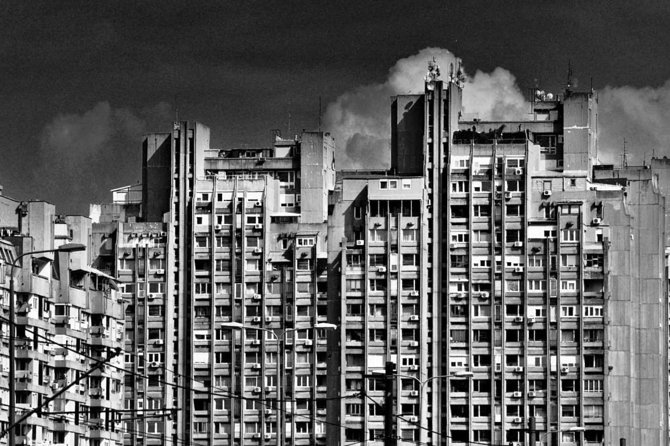
New Belgrade makes the perfect case for looking twice. Its huge concrete blocks, sharp angles, marble walls, and wide open spaces tell the story of Yugoslavia’s political ambitions better than a string of monuments can. This private tour moves through five important buildings and adds the human side, including daily life in the housing blocks.
I like the small private format, since your guide can focus on the architecture and questions that interest you. I also like the route’s variety: the Museum of Contemporary Art, Genex Tower, Sava Center, a school, a housing block, and the Park of Friendship all show different sides of New Belgrade.
The main consideration is pace. The advertised duration is about 2 hours 30 minutes, but one account describes a tour of less than two hours, so the actual timing may depend on traffic, stops, and the guide. The museum admission is not included, and the tour is best for people who enjoy buildings, history, and urban details more than classic postcard sights.
Key points to know before booking
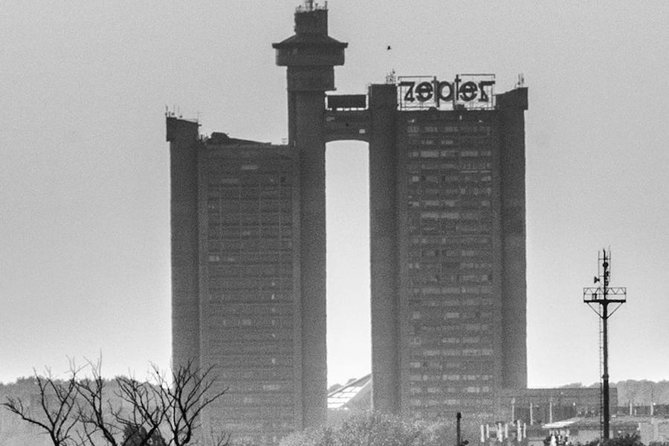
- Genex Tower is the visual star: Get close to the 30-floor Western City Gate, one of Belgrade’s most memorable concrete landmarks.
- The route goes beyond architecture: Hear how life worked in Block 23 during the 1960s, 1970s, and 1980s, and how the 1990s changed that experience.
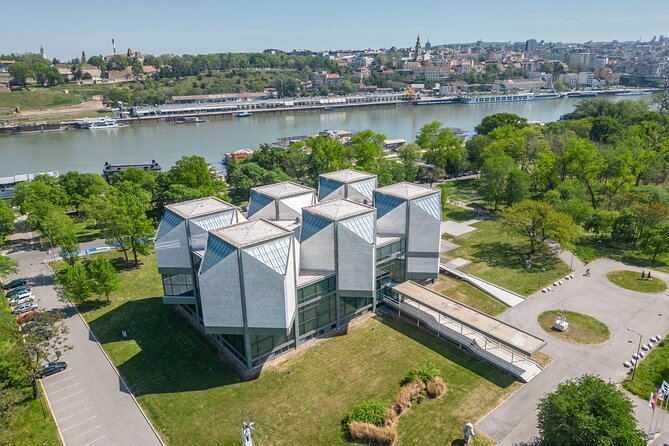
- The Museum of Contemporary Art sets the tone: Its marble facades and modernist forms challenge the usual image of socialist construction.
- You visit five main sites: The route includes the museum, Park of Friendship, Genex Tower, Sava Center, and Primary School Laza Kostić.
- It is a private English-language tour: Only your group takes part, giving you a more personal setting for questions and discussion.
- The start and finish are convenient: Meet at the Museum of Contemporary Art in Ušće and finish at Sava Center.
Why New Belgrade is worth two and a half hours
Most first-time visits to Belgrade focus on the old town, the fortress, riverside streets, and traditional cafés. New Belgrade offers a very different view. Built largely after the Second World War, it expresses the confidence of socialist Yugoslavia through scale: enormous apartment blocks, formal public spaces, civic buildings, and broad areas between them.
That scale can be hard to read on your own. A block of apartments may look like a wall of concrete until somebody explains the original plan. Housing, schools, kindergartens, sports courts, and small shopping areas were meant to work together as a complete neighborhood. This tour helps you see that planning idea rather than treating New Belgrade as a collection of oversized buildings.
The brutalist label also needs some care. Not every building here fits the strictest definition of brutalism. Some belong to modernism or concrete expressionism, and some use polished marble or carefully designed interiors. That mix is one of the tour’s strengths. You get to compare different design choices instead of hearing one simple story about gray concrete.
The price is $86.42 per person. For a private tour lasting about 2 hours 30 minutes, that can be fair if you want an organized route and a guide who connects architecture with politics and ordinary life. It is not a bargain sightseeing walk, especially if you are traveling alone. The value improves for two or more people sharing the private booking, since the guide’s time is reserved for your group.
Other Belgrade days people book alongside this one:
- From Belgrade: Novi Sad & Sremski Karlovci Full-Day Tour
★ 4.7 · 1,068 reviews - From Belgrade: Gems of Eastern Serbia Tour
★ 5.0 · 427 reviews - Northern Serbia: Sremski Karlovci and Novi Sad Full-Day Tour from Belgrade
★ 5.0 · 425 reviews
Meeting the guide at the Museum of Contemporary Art
The tour begins outside the Museum of Contemporary Art at Ušće, at Ušće 10. That is a clear meeting point, and the museum gives you an immediate introduction to the design language you will see throughout New Belgrade.
The building’s 1960s forms are modernist rather than simply stark. Its marble facades are especially useful for correcting the lazy idea that socialist architecture was always cheap, rough, and gray. Here, the materials were precious, and the building was meant to project cultural confidence.
You spend about 20 minutes at the museum. Admission is not included, so the tour appears to focus on the exterior rather than a full museum visit. If you want to see the collections, plan that separately and confirm how much time your guide will spend inside or outside before you arrive.
This first stop works well because it gives you a question to carry through the rest of the route: how does architecture reveal a country’s ambitions? At the museum, the answer comes through refined materials and sculptural forms. Later, the answer comes through state buildings, transportation links, public housing, and large event spaces.
Peace, politics, and trees at Park of Friendship
The short stop at Park of Friendship lasts about 15 minutes. It is free, and the park provides an open-air pause after the museum.
This is where the guide introduces the Non-Aligned Movement, which was founded in Belgrade in 1961 and eventually included 120 countries. Heads of state planted trees here as symbols of peace. That detail gives the park a clear political meaning, but it also shows how Yugoslavia presented itself: independent of both the Soviet bloc and the Western power structure.
The park is not the kind of place you visit for a long list of monuments. Its importance comes from the connection between landscape, diplomacy, and national identity. You are looking at a public space shaped by international politics, not only local city planning.
The stop is brief, so do not expect a long park walk. Its purpose is to place New Belgrade inside the wider story of Yugoslavia before the tour returns to concrete buildings and civic projects.
Passing the Government Building and the Soviet break
The route also drives by the large Government Building. This is not listed as one of the timed main stops, so expect a view and an explanation rather than a long visit.
The building represents an earlier phase of Yugoslav politics. Its construction began before the country’s break with Stalin, and the design experienced that political shift while work was still underway. That makes the building a useful bridge between architecture and changing ideology.
You may not get a close look, but the drive-by matters. It reminds you that New Belgrade was not planned under one fixed political mood. Its buildings reflect changes in Yugoslavia’s relationship with the Soviet Union, its growing independence, and its effort to create a distinct identity.
This is also one reason the private format helps. A guide can explain the political background in plain language and connect it to what you are seeing, instead of leaving you with a building that is impressive but difficult to place.
Same riverbank, a completely different kind of day:
- Day Trip from Belgrade: Gems of Eastern Serbia
★ 5.0 · 424 reviews - Western Serbia 1-Day Tour of the Key Sites from Belgrade
★ 4.8 · 333 reviews - Belgrade Nightlife Bar Pub Club Crawl with Drinks
★ 5.0 · 277 reviews - From Belgrade: Golubac Fortress and Iron Gate Gorge Tour
★ 4.8 · 271 reviews
Genex Tower, New Belgrade’s most dramatic landmark
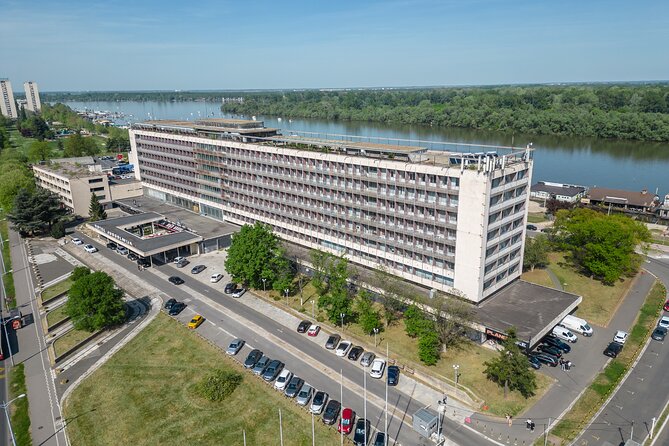
At Narodnih heroja 45, you get a close look at Genex Tower, also called the Western City Gate of Belgrade. This is the tour’s strongest visual stop for many people.
The 30-floor structure was built about 40 years ago and became an internationally noted example of brutalist architecture. Its two-part form gives it a powerful presence, and it has become one of the easiest New Belgrade buildings to recognize in photographs.
The tower was also described as the first smart building in the Balkans. That claim reflects the technology and ambition associated with the complex when it was built. It was not intended as ordinary housing alone. It represented a forward-looking city and a belief that modern architecture could organize modern life.
You spend about 20 minutes here, with free admission. The close-up view is important because Genex Tower loses some of its force when seen only from a distance. At ground level, you can better judge its materials, scale, and relationship to the surrounding city.
There is a practical limit. This is an exterior stop, and the tour does not promise access to the tower’s interiors. You are paying for interpretation and a carefully chosen viewpoint, not for a visit to the upper floors.
Sava Center and the confidence of the late 1970s
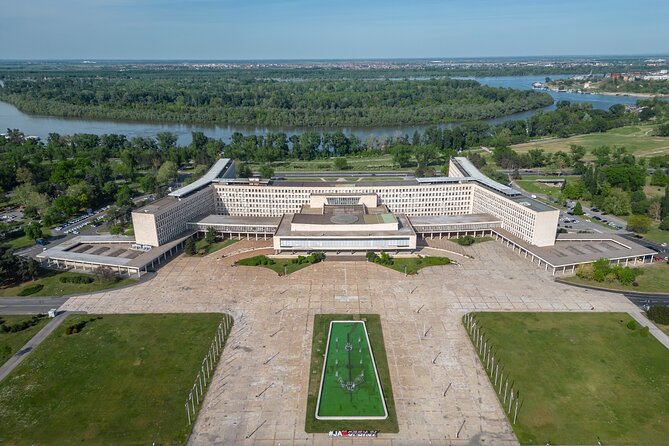
The Sava Center is the final stop listed before the tour ends. It was built at the end of the 1970s in record time and was the first building of its type in this part of Europe. It remains in use as a congress center.
The building shows a later stage of Yugoslav confidence. Instead of focusing only on apartment blocks, the country was presenting itself as a place capable of hosting major international events. The scale is huge, but the interior design is more interesting than you might expect.
You spend about 15 minutes here. The stop is valuable because it shifts your attention from the outside shell to the way a large public building works inside. The interior solutions were considered surprisingly well designed and still feel fresh after four decades.
Your tour ends at Sava Center, at Milentija Popovića 9. Finishing here is convenient if you want to continue exploring the New Belgrade riverfront or use public transportation. The information provided does not specify your onward route, so check your own plans before booking if you need to return to the old town immediately.
Block 23 and the human side of concrete expressionism
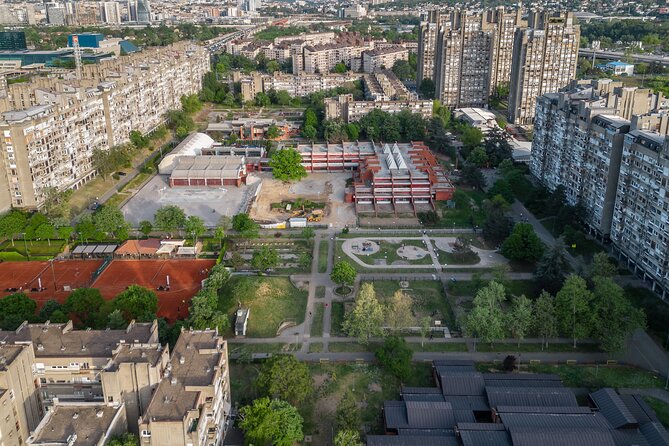
Primary School Laza Kostić takes you into Block 23, described as the most representative public housing project on the route. This is where the tour moves beyond famous architecture and asks what it was like to live in these buildings.
The plan was designed as a complete neighborhood. Apartment buildings were placed with a school, kindergarten, sports courts, and a small shopping mall. In theory, residents could find the daily services they needed close to home rather than crossing the city for every errand.
That planning idea is more useful than simply calling the area brutalist. You can look at the buildings as part of a social project, one that tried to provide housing and basic community services together. The design also belongs to the style described as concrete expressionism, so it gives you another point of comparison with Genex Tower and Sava Center.
The guide’s personal stories about life in the blocks during their golden decades of the 1960s, 1970s, and 1980s add a human layer. You hear about everyday life when the neighborhood was new and the system behind it seemed to be working. You also hear how living conditions and public life became less positive during the 1990s.
That contrast is one of the best reasons to book this tour. You are not asked to admire concrete without question. You are encouraged to consider both the promise of the original plan and the harder reality that followed.
The stop lasts about 15 minutes, so it is an introduction rather than a long residential walk. Still, it may be the most revealing part of the route. Famous towers attract attention, but a school and housing block show how political ideas reached ordinary homes.
What the private format adds
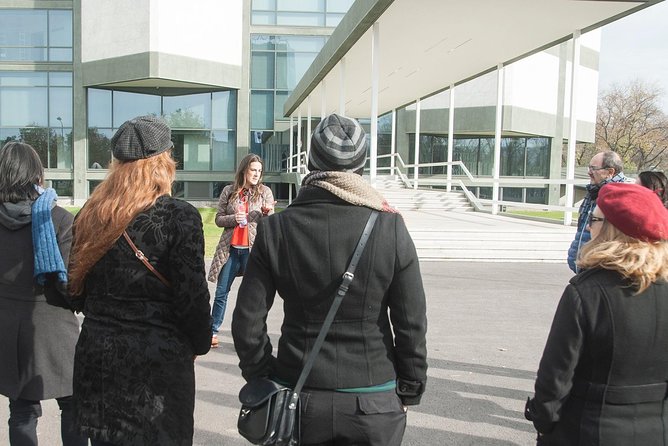
Only your group takes part, which changes the feel of the experience. You can ask why a building looks the way it does, stop over a detail, or request more explanation about Yugoslavia, architecture, or local life.
A private tour also helps with a subject that can become technical. Brutalism, modernism, concrete expressionism, smart buildings, and socialist planning are easier to understand when the guide responds to your level of interest. One guide named Xenia has been specifically associated with explaining New Belgrade’s history and architecture, though your assigned guide may differ.
The strongest praise for this experience centers on guide quality, punctuality, clear explanations, and the way architecture is connected to everyday life. That is exactly what you should want from this route. A list of construction dates would not be enough. The buildings become useful only when you understand what they were meant to do.
There is one sharply negative account, describing the experience as disappointing, under two hours, and lacking preparation or personal connection. That criticism is worth keeping in mind. The tour’s success depends heavily on the guide and on whether the actual timing matches the advertised 2 hours 30 minutes. If you book, arrive ready to ask questions and confirm the planned route at the start.
Who will get the most from this tour
I would choose this experience if you like architecture, political history, photography, urban planning, or the everyday stories behind big public projects. It is also a strong choice if you have already seen central Belgrade and want a different side of the city.
You do not need specialist knowledge. The route is built to explain why the buildings matter, not to test you on architectural terms. Still, you should have some patience for exterior stops, short explanations, and a drive between locations.
This is less suitable if you want a relaxed café walk, a museum-heavy outing, or a conventional list of Belgrade’s oldest sights. The buildings are large, planned, and sometimes visually severe. The reward comes from learning how to read them.
The tour is offered in English and is near public transportation. Most people can participate, but the provided information does not give detailed accessibility notes. If you have specific mobility needs, ask the provider before booking.
Timing, cost, and practical details
Allow about 2 hours 30 minutes, while keeping in mind that actual timing may vary. The timed visits total about 85 minutes, with driving and explanations accounting for the rest. The route begins at the Museum of Contemporary Art and ends at Sava Center, so it is not a loop back to the start.
The price is $86.42 per person. That cost makes the most sense for a couple, family, or small group that wants a private guide. Solo visitors may find it expensive compared with exploring New Belgrade independently, but independent sightseeing will not provide the same explanation of the Non-Aligned Movement, political changes, architectural goals, and life in Block 23.
The museum ticket is not included. The other listed stops have free admission, and several are viewed from public areas. You receive booking confirmation at the time of reservation, and free cancellation is available until at least 24 hours before the start time. Changes or cancellations inside that window are not accepted for a refund.
Should you book Architecture of New Belgrade?
Book it if you want to understand why New Belgrade looks the way it does, not just photograph a few striking towers. The combination of Genex Tower, Sava Center, the museum, Park of Friendship, and Block 23 gives you architecture, diplomacy, public housing, and personal stories in one compact route.
I would be cautious if your schedule is tight or if you need a guaranteed full 2 hours 30 minutes. Confirm the meeting details and expected duration, and remember that the museum admission is extra. For the right audience, though, this is a thoughtful private tour that turns an often-overlooked part of Belgrade into a readable, human city.
FAQ
Where does the tour begin?
The tour begins in front of the Museum of Contemporary Art at Ušće 10 in Belgrade, Serbia.
Where does the tour end?
The tour ends at Sava Center, Milentija Popovića 9, Belgrade 11000.
How long does the experience last?
The advertised duration is approximately 2 hours 30 minutes. Actual timing may vary, and one account describes a shorter experience.
Is the tour private?
Yes. Only your group participates in the activity.
What language is the tour offered in?
The tour is offered in English.
Is admission to the Museum of Contemporary Art included?
No. Admission to the Museum of Contemporary Art is not included.
What buildings and sites are visited?
The route includes the Museum of Contemporary Art, Park of Friendship, Genex Tower, Sava Center, and Primary School Laza Kostić in Block 23. The Government Building is viewed while driving by.
Just added around Belgrade
- Private Wine Tasting by Party in Belgrade★ 5.0 · 3 reviews
- Zica and Studenica Monasteries Private Day Tour from Belgrade★ 5.0 · 4 reviews
- Urban & Alternative Belgrade tour★ 5.0 · 4 reviews
- Belgrade Bike Tour: Be a local in the hood of Belgrade!★ 5.0 · 5 reviews
- Sidecar Tours Belgrade★ 5.0 · 5 reviews
- The World of Pubs and Taverns: A Golden Mile★ 5.0 · 5 reviews
- Private Truffle‑Hunting Tour from Belgrade – Lunch with Wine★ 5.0 · 4 reviews
- Private Day Trip/Transfer Tour from Belgrade to Timisoara★ 5.0 · 5 reviews
Belgrade Tours, compared.
Sremski Karlovci and Novi Sad Full-Day Tour from Belgrade
Read our review →
Day Trip from Belgrade: Gems of Eastern Serbia
Read our review →
Western Serbia 1-Day Tour of the Key Sites from Belgrade
Read our review →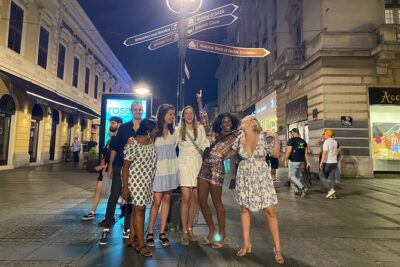
Belgrade Nightlife Bar Pub Club Crawl with Drinks
Read our review →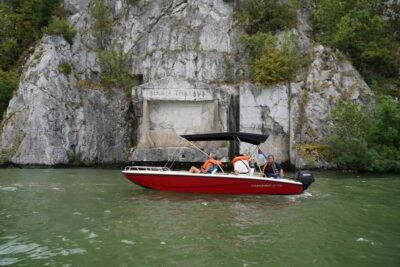
Browse the lists this tour appears in