
Reviewed · TOURS
Communist Tour in Belgrade
Belgrade’s communist past is not locked away in one museum. It is spread across grand squares, government buildings, trolleybus routes, and the bombed shell of Generalštab. This tour connects those places into a clear story, with special value in its fact-based treatment of Tito, Yugoslavia, and the 1990s. I also like the small group limit of 15 and the Museum of Yugoslavia visit, which gives the walk a strong finish.
The guides have included Stefan, Michael, and Milan, and the experience depends heavily on who leads your group. The main consideration is pace: three hours includes a lot of serious history, several outdoor stops, and a trolleybus ride, so this is better for you if you enjoy listening and looking closely than if you want a relaxed sightseeing stroll.
Key points about Belgrade’s Communist Tour
- Tito’s story reaches beyond statues and slogans: You hear about the Youth Relay Baton, the Non-Aligned movement, and the political system that made Yugoslavia different from both the Soviet bloc and the West.
- Generalštab gives the past a physical presence: The damaged Ministry of Defence complex remains a stark reminder of the 1999 NATO bombing.
- The Museum of Yugoslavia is included: Your ticket covers entry, including access to the museum complex where Tito’s grave is located in the House of Flowers.
- The route uses Belgrade’s public transport: A trolleybus ride of about 15 minutes links central Belgrade with the museum area, and the ticket is included.
- The group is capped at 15 people: That is a useful size for questions and discussion without turning the walk into a private tour price.
- English is the tour language: Previous guides have included Stefan, Michael, and Milan, each praised for clear, thoughtful explanations and strong command of the subject.
Why this three-hour route helps explain Belgrade
A communist-history tour can easily become a parade of dates and political names. This one has a more useful shape. It begins in the center of Belgrade, where modern Serbia’s public life is still visible, then moves through state buildings and diplomatic streets before reaching the physical evidence of war at Generalštab. The final stop is the Museum of Yugoslavia, where the story gains objects, photographs, and Tito’s memorial site.
You should expect a serious subject, but not a dry lecture. The route covers Josip Broz Tito, the Youth Relay Baton, the Non-Aligned movement, the conflicts of the 1990s, the NATO bombing of Serbia and Montenegro in 1999, and the democratic changes that followed at the start of the third millennium.
That range is the tour’s main strength. If you know little about Yugoslavia, the guide can give you the basic framework. If you already know the broad story, the locations help you connect political events to the city around you.
The tour starts at 3 p.m. in Republic Square and ends at the Museum of Yugoslavia. The price is $24.03 per person. Since the Museum of Yugoslavia admission and trolleybus ticket are included, I consider the price fair, particularly if your main aim is to understand Belgrade rather than simply collect landmark photographs.
Other Belgrade days people book alongside this one:
- From Belgrade: Novi Sad & Sremski Karlovci Full-Day Tour
★ 4.7 · 1,068 reviews - From Belgrade: Gems of Eastern Serbia Tour
★ 5.0 · 427 reviews - Northern Serbia: Sremski Karlovci and Novi Sad Full-Day Tour from Belgrade
★ 5.0 · 425 reviews
Republic Square: Tito, the baton, and modern Serbia
Republic Square is a sensible starting point because it places the tour in the middle of present-day Belgrade. From here, the guide introduces the political forces that shaped Yugoslavia and its successor states.
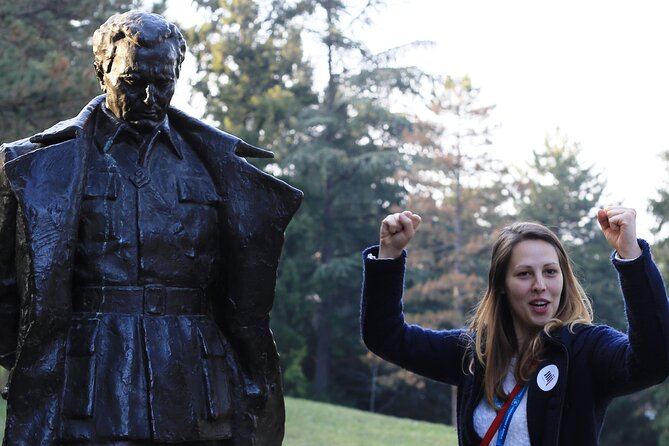
This is where you begin with Tito, the leader whose image and political methods still shape how many people understand the former country. The discussion includes the Youth Relay Baton, a major symbolic ritual in socialist Yugoslavia, and the Non-Aligned movement, which helped Yugoslavia pursue a position outside the direct control of either the United States or the Soviet Union.
The stop also reaches into the conflicts of the 1990s, the 1999 NATO bombing, and the democratic changes that came at the beginning of the new millennium. That is a lot for 15 minutes, so listen for the basic sequence rather than expecting every political detail to be settled here.
I like this opening because it avoids treating communism as a sealed-off chapter. You are standing in a working city while the guide explains how those earlier choices still affect Serbia’s public debates and identity.
mts Dvorana and the look of Socialist realism
The next short stop is mts Dvorana, formerly known as Dom Sindikata, or Trade Union Hall. The building was designed by Branko Petričić, and construction began in 1947. Its Socialist realist style gives you a direct example of how architecture served the new state after the Second World War.
You do not go inside according to the supplied route, and admission is free. The value is in learning how to read the exterior. Massive scale and formal design were not accidental. They helped project strength, collective purpose, and the importance of organized labor.
Fifteen minutes is enough for an introduction, though you should not expect an architectural tour in its own right. Think of this as a visual pause that makes the political story easier to grasp. The building gives the guide something solid to point toward while explaining the public image Yugoslavia wanted to create.
The National Assembly and the changing Serbian state
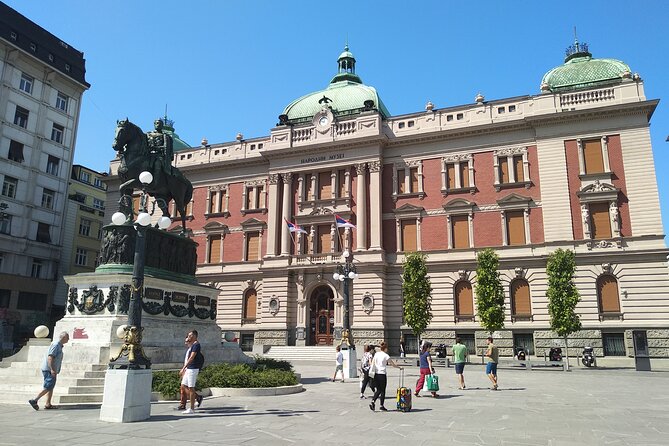
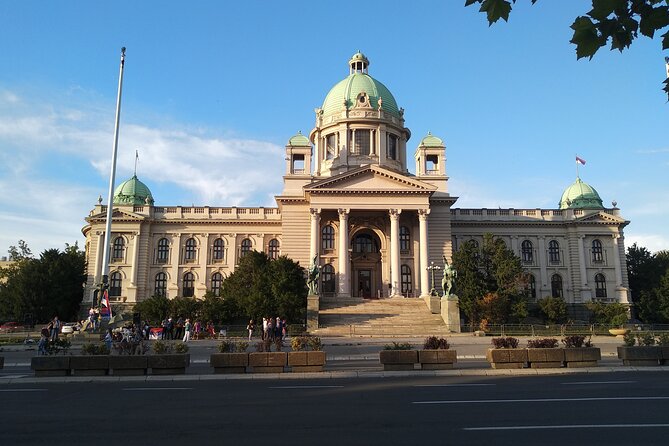
At the House of the National Assembly, the tour shifts from ideology to government. The building sits on Nikola Pašić Square and is both a functioning political institution and a major Belgrade landmark.
Completed in 1936, it served as the Parliament of Yugoslavia and later the Parliament of Serbia and Montenegro before becoming the seat of Serbia’s National Assembly. That changing role makes the building useful for explaining the complicated chain of states that followed the Kingdom of Yugoslavia.
The guide can show you that political history here is not a simple line from monarchy to communism to today. The same building has housed different governments and represented different ideas of the state. For anyone confused by the names Yugoslavia, Serbia and Montenegro, and modern Serbia, this stop offers an important piece of the puzzle.
Again, the scheduled time is about 15 minutes. You will hear the key context, but you will not explore the interior. The stop works best when you pay attention to the building’s changing political purpose, not just its formal facade.
Same riverbank, a completely different kind of day:
- Day Trip from Belgrade: Gems of Eastern Serbia
★ 5.0 · 424 reviews - Western Serbia 1-Day Tour of the Key Sites from Belgrade
★ 4.8 · 333 reviews - Belgrade Nightlife Bar Pub Club Crawl with Drinks
★ 5.0 · 277 reviews - From Belgrade: Golubac Fortress and Iron Gate Gorge Tour
★ 4.8 · 271 reviews
Kneza Miloša Street and Belgrade’s power corridor
Kneza Miloša Street provides a change of mood. It was once the city’s main korzo, or promenade, and is now one of Belgrade’s major traffic arteries. It also contains important national institutions and more embassies than any other street in the city.
This is a good place to see how a street can carry several layers of urban life at once. Its earlier role as a promenade suggests a social city center, while its current government and diplomatic functions point to state power and international relations.
The stop lasts about 20 minutes, slightly longer than most of the central landmarks. Use that time to follow the guide’s connections between buildings, embassies, and the political geography of Belgrade. You may find this section less dramatic than Generalštab, but it gives the route useful context.
There is also a practical point here. Much of the tour takes place outdoors beside active city streets. Comfortable shoes and attention to traffic make sense, even though most travelers can participate and the route stays near public transportation.
Generalštab: architecture marked by the 1999 bombing
Generalštab is likely to be the most powerful stop before the museum. The former Yugoslav Ministry of Defence and General Staff complex was designed as a major work of postwar architecture. It was heavily damaged during the NATO bombing of Yugoslavia in 1999.
The ruined structure makes the recent past hard to keep abstract. You are not simply hearing about the bombing in a classroom. You are looking at a building that still carries its damage in central Belgrade.
The guide’s job here is especially important. The subject remains politically and emotionally charged, and a useful explanation needs to separate military events, civilian experience, international decisions, and Serbian memory. The strongest part of this tour is its stated effort to present difficult events objectively, rather than forcing you into a single slogan.
You spend about 15 minutes at Generalštab. That is enough to understand why the building matters, but not enough for a long architectural study or a detailed military timeline. If this is the stop you most want to examine, take note of the exterior as the guide speaks and consider returning independently later if appropriate.
The trolleybus ride to the Museum of Yugoslavia
After Generalštab, the group takes a trolleybus toward the Museum of Yugoslavia. The ride lasts about 15 minutes, and the ticket is included.
This transfer is more than a way to fill a gap between stops. It lets you use the same public transport system that connects Belgrade’s central districts with the museum area. One guide, Michael, was specifically praised for explaining the transit system, so this part may be particularly useful if you are still getting your bearings in the city.
The ride also breaks up the walking and gives you a chance to process the central-city stops. Keep your ticket arrangements simple by confirming with the guide how the included fare is handled. The tour is designed as one connected experience, not as separate transport and museum bookings.
The Museum of Yugoslavia and Tito’s final resting place
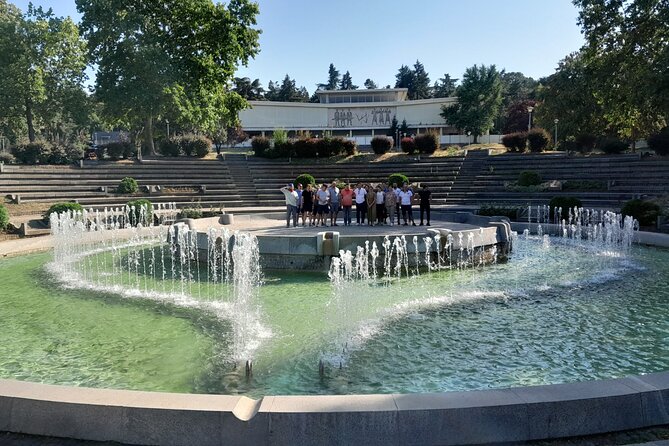
The tour saves about an hour for the Museum of Yugoslavia, and this is where the route gathers its evidence. The museum covers both the Kingdom of Yugoslavia and Socialist Yugoslavia, along with the life of Tito.
Most importantly, Tito’s grave is in the House of Flowers, one of the museum buildings. That makes the visit more than a general history display. It gives you a direct look at how Tito is remembered and presented in Serbia today.
The museum receives about 120,000 visitors a year, making it Serbia’s most visited museum. The admission fee is included in the tour, which improves the overall value. You do not have to decide afterward if you want to pay for one more museum visit, and the guide can frame the displays using the political background covered earlier.
One hour is a useful amount of time, but it is not enough for every display at a slow pace. Listen carefully to the guide’s explanation, then use any remaining minutes for the objects or sections that interest you most. If you prefer museums at a very leisurely pace, you may want to return on another visit.
The museum also gives you a chance to compare public ritual with private memory. The Youth Relay Baton and Tito’s political image belong to a world of organized ceremony and collective identity. The museum setting asks you to consider what remains of that world after Yugoslavia’s collapse.
Guides, group size, and the quality of explanation
The guide can make or break a tour about recent history. The people leading this experience have included Stefan, Michael, and Milan.
Stefan has a particularly strong reputation for handling modern Serbian history with careful facts, nuance, and insight. He has also provided book and documentary suggestions when asked. That is useful if the tour leaves you wanting to learn more, which is likely if you are new to Yugoslav history.
Milan has been praised for an objective presentation of both the distant and recent past. Michael has been noted for his enthusiasm and for knowing Belgrade’s transit system well. Since the specific guide is not guaranteed, you should book this for the structure and subject as well as for any one individual.
The group limit is 15 people. That is small enough for questions to be practical, yet large enough to keep the $24.03 price down. The tour is offered in English, and confirmation is provided when you book.
Who gets the best value from the $24.03 price
I would recommend this tour most strongly if you have little background on Yugoslavia or if the 1990s events feel confusing. The guide links symbols, buildings, architecture, transport, and museum objects in a way that is hard to reproduce from a guidebook during a short stay.
The value is also good for a first visit to Belgrade. The tour begins at Republic Square, covers several central landmarks, uses a trolleybus, and ends at a major museum. You get both orientation and historical context for about three hours.
The price may feel less attractive if you already have a strong command of Yugoslav political history and prefer to explore museums alone. Several outdoor stops are brief, and the central buildings are viewed from outside. In that case, the tour’s value depends on how much you want interpretation and discussion.
Group discounts are available, which may help if you are booking for several people. Personal expenses are not included, but the listed admission and trolleybus fare are covered.
Practical details before you book
Meet at Republic Square in Belgrade at 3 p.m. The tour ends in front of the Museum of Yugoslavia at Mihaila Mike Jankovića 6, Belgrade 11000. Plan your return from the museum rather than assuming you will finish back in the central square.
The experience is near public transportation, and most people can participate. Because the route combines city walking, outdoor explanations, and a trolleybus ride, wear shoes you can use comfortably for three hours.
Free cancellation is available if you cancel at least 24 hours before the local start time. Changes or cancellations made later are not accepted for a refund. The experience requires a minimum number of participants, so if the operator cancels it for that reason, you are offered another date or experience, or a full refund.
Should you book Belgrade’s Communist Tour?
Book it if you want more than a quick look at Tito memorabilia. The strongest reasons are the route through real political sites, the damaged Generalštab building, the included Museum of Yugoslavia entry, and guides such as Stefan, Michael, and Milan who can explain difficult events in clear English.
Skip it if you want a gentle city walk with little political discussion, or if you need long, unhurried time inside each museum section. For most people curious about Belgrade’s twentieth-century story, though, the $24.03 price buys a useful framework, a manageable three-hour route, and a better understanding of why this city looks the way it does.
FAQ
Where does the Communist Tour in Belgrade start?
The tour starts at Trg Republike, or Republic Square, in Belgrade.
What time does the tour begin?
The scheduled start time is 3 p.m.
Where does the tour end?
The tour ends in front of the Museum of Yugoslavia at Mihaila Mike Jankovića 6, Belgrade 11000.
How long does the experience last?
The tour lasts approximately three hours.
Is the Museum of Yugoslavia entrance included?
Yes. Entrance to the Museum of Yugoslavia is included in the tour price.
Is the trolleybus ticket included?
Yes. The trolleybus ticket is included, and the ride from Generalštab to the museum takes about 15 minutes.
What language is the tour offered in?
The tour is offered in English.
How many people can join the group?
The maximum group size is 15 travelers.
Can I cancel for a full refund?
Yes, if you cancel at least 24 hours before the experience’s local start time. Cancellations made less than 24 hours before the start are not refunded.
Just added around Belgrade
- Private Wine Tasting by Party in Belgrade★ 5.0 · 3 reviews
- Zica and Studenica Monasteries Private Day Tour from Belgrade★ 5.0 · 4 reviews
- Urban & Alternative Belgrade tour★ 5.0 · 4 reviews
- Belgrade Bike Tour: Be a local in the hood of Belgrade!★ 5.0 · 5 reviews
- The World of Pubs and Taverns: A Golden Mile★ 5.0 · 5 reviews
- Private Truffle‑Hunting Tour from Belgrade – Lunch with Wine★ 5.0 · 4 reviews
- Sidecar Tours Belgrade★ 5.0 · 5 reviews
- Private Day Trip/Transfer Tour from Belgrade to Timisoara★ 5.0 · 5 reviews
Tours, compared.
Sremski Karlovci and Novi Sad Full-Day Tour from Belgrade
Read our review →
Western Serbia 1-Day Tour of the Key Sites from Belgrade
Read our review →
From Sofia: Day Tour to Nis, Serbia with tickets and pick-up
Read our review →
Belgrade Big Tour: Top Attractions and Belgrade Neighborhoods
Read our review →Browse the lists this tour appears in