
Reviewed · WALKING TOURS
Belgrade Old City 2-Hour Walking Tour
Belgrade reveals its story in layers: Roman walls beneath medieval gates, Ottoman traces beside Orthodox churches, and grand 19th-century buildings lining pedestrian streets. This private walking tour brings those layers together, ending with the sweeping meeting point of the Sava and Danube rivers from Kalemegdan Fortress.
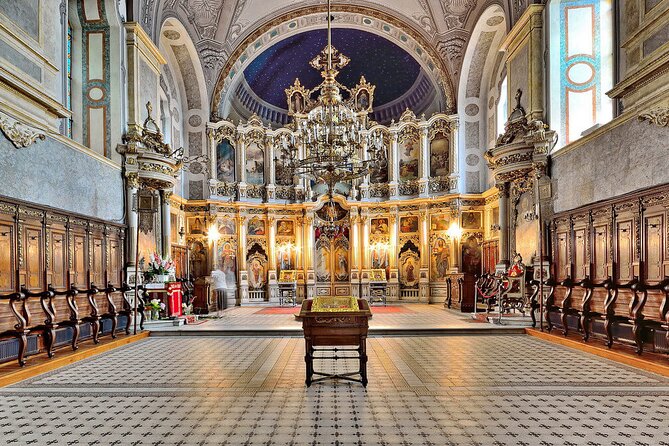
I especially like the way the route links major sights with smaller human stories, from Captain Miša’s generosity to Belgrade’s Jewish community and the destruction of the National Library. I also like that the tour includes Ružica Church, whose chandeliers are made from spent cartridges, cannon ammunition, swords, and pistols.
The main consideration is the pace and length. The advertised duration is two to three hours, but the route covers a lot of ground, including cobblestones and an uphill walk back to the center. At $60.08 per person, it makes the most sense for a private group that wants a focused introduction rather than a quick, low-cost group walk.
Key points at a glance
- A private walk through Belgrade’s central districts: Your own group takes the tour, with an English-speaking guide leading the way.
- The route covers major city symbols: See Republic Square, Knez Mihailova, Kalemegdan Fortress, the Sava and Danube confluence, and the Victor monument.
- Ružica Church is the unusual highlight: Its striking chandeliers use military objects from the Salonika Front.
- You get more than monuments: The guide explains Ottoman Belgrade, the Jewish community, wartime destruction, Serbian history, and city life today.
- The walk ends where it starts: Begin and finish at Republic Square, near the Prince Mihailo monument.
- Plan for real walking: The route includes fortress paths, cobblestones, park paths, and a climb back toward the center.
Starting at Republic Square with Prince Mihailo
Meet your guide at Republic Square, in front of the equestrian monument to Prince Mihailo. This is a useful starting point because the square gives you an immediate introduction to Belgrade’s public life and modern Serbian history.
The guide points out the National Museum and National Theatre, two of the important buildings facing the square. You also get a short explanation of Prince Mihailo’s role in Serbia’s modern development, which helps place the city’s 19th-century architecture in context.
This opening is brief, about 10 minutes, but it does useful work. You learn how to read the city center before moving into older districts. If you have just arrived in Belgrade, this is also a practical spot from which to get your bearings.
A few more Belgrade trips to weigh up
- Belgrade: 3-Hour Small Group Walking Tour
★ 5.0 · 180 reviews - Half-Day Sightseeing and Walking Tour of Belgrade City
★ 5.0 · 37 reviews - Belgrade Private Walking Tour with a Local
★ 5.0 · 19 reviews
Studentski Trg and the city’s academic heart
A short walk brings you to Studentski Trg, or Student Square. It is described as Belgrade’s oldest urban square, with a park in the center and a fine group of classical buildings around it.
Belgrade does not have one enclosed university campus. Instead, several important educational institutions are gathered here, including the faculties of philosophy, philology, mathematics, and natural sciences. The grand Captain Miša’s Edifice serves as the headquarters of the University of Belgrade.
The story here is not only about architecture. Captain Miša is remembered for his charity and generosity, and the guide connects the square with major Serbian thinkers and scientists. This gives the stop more life than a simple list of building names.
You spend about 10 minutes here. That is enough for an introduction, though anyone interested in Serbian education or architecture may wish to return later and explore at a slower pace.
Dorćol and the story of Belgrade’s Jewish community
The route continues into Dorćol, one of the city center’s most characterful neighborhoods. Today, the area has cafés, galleries, restaurants, museums, and a strong local identity. Its name comes from a colloquial Turkish expression meaning crossroads, a reminder of its role as a trading point during Ottoman rule.
The tour pauses near the Jewish community center. Here, the guide explains the everyday life and work of Belgrade’s Jewish community, followed by the terrible fate that befell it during the Second World War.
This is one of the most valuable parts of the walk because it moves beyond kings, armies, and grand buildings. You hear about a community and its place in the city, then face the impact of wartime persecution. The subject is serious, but it belongs in any honest account of Belgrade.
The stop lasts around 15 minutes. If you prefer tours that explain how different communities shaped a city, this section adds real weight to the route.
Bayrakli Mosque and Ottoman Belgrade
Bayrakli Mosque, or Bajrakli džamija, is the only surviving mosque in Belgrade. Built in the 16th century, it offers a direct link to the city’s Ottoman period.
The guide uses the building to explain how Belgrade looked and functioned under Ottoman rule. That matters because the city’s past is not a single Serbian or Austro-Hungarian story. Belgrade changed hands and character many times, and this mosque is one of the clearest surviving reminders of Ottoman influence.
The visit is scheduled for about 15 minutes. The tour data does not promise a formal interior visit, so think of this primarily as a historical stop rather than a guaranteed religious-site entry. Dress and behave respectfully, especially if worship is taking place.
Same riverbank, a completely different kind of day:
- From Belgrade: Novi Sad & Sremski Karlovci Full-Day Tour
★ 4.7 · 1,068 reviews - From Belgrade: Gems of Eastern Serbia Tour
★ 5.0 · 427 reviews - Northern Serbia: Sremski Karlovci and Novi Sad Full-Day Tour from Belgrade
★ 5.0 · 425 reviews - Day Trip from Belgrade: Gems of Eastern Serbia
★ 5.0 · 424 reviews
Entering Kalemegdan through old fortress gates
From the mosque, you continue toward Kalemegdan, the oldest and largest park in central Belgrade. The park surrounds the fortress and gives the walk a welcome change of pace after the dense streets of Dorćol.
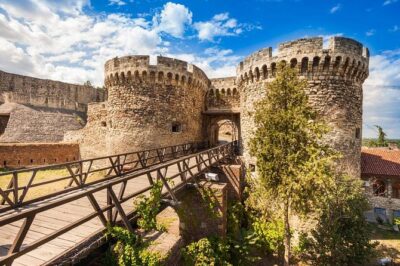
The fortress section begins near Leopold’s Gate. Along the route, you see traces of the Roman castrum of Singidunum, the settlement that preceded modern Belgrade. Medieval walls were later built over and around those earlier remains.
The guide takes you past Zindan Gate, Despot’s Gate, and Jakšića Tower, all connected with the fortress’s 15th-century defenses. These are not isolated ruins. Together, they show why this high ground mattered for control of the city and the rivers.
The schedule allows about 15 minutes for this first fortress section, followed by a separate stop at Ružica Church. The route gives you a broad introduction rather than time for a detailed archaeological inspection.
Ružica Church and its unusual military chandeliers
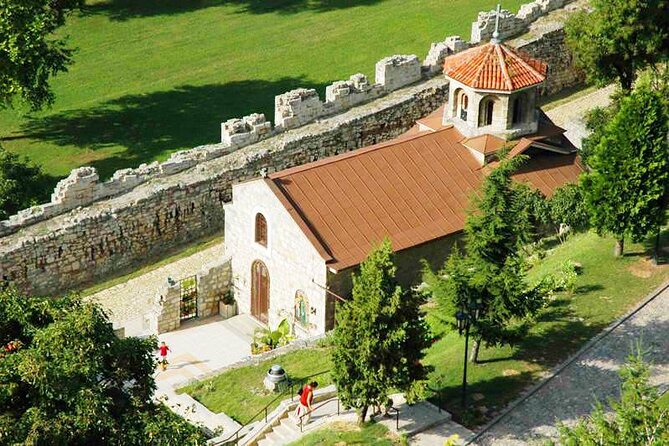
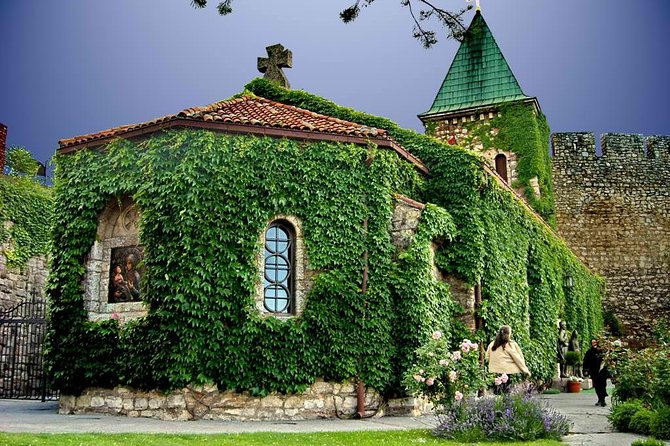
Ružica Church, also called the Church of the Holy Mother of God, is one of the most memorable stops. The building was constructed as a church around 1875, but before that it served as a gunpowder magazine and a military school.
Inside, three chandeliers are made from spent cartridges, cannon ammunition, officers’ swords, and soldiers’ pistols from the Salonika Front. The effect is unusual and visually powerful. You are looking at a religious interior decorated with objects tied to war, a contrast that gives the church much of its character.
Ružica is described as Belgrade’s oldest Orthodox church and one of its most visually striking religious buildings. A service may be taking place when you arrive. In that case, expect the guide to ask you to respect the service and avoid photographs. A quiet few minutes inside can be more meaningful than a hurried attempt to document the room.
This stop receives about 15 minutes. The actual experience may depend on church activity at the time of your visit, so treat interior access and photography as matters of circumstance and courtesy.
The Upper Town and the meeting of two rivers
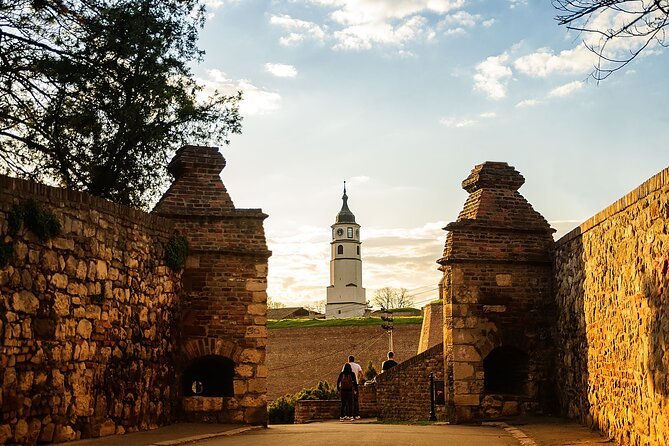
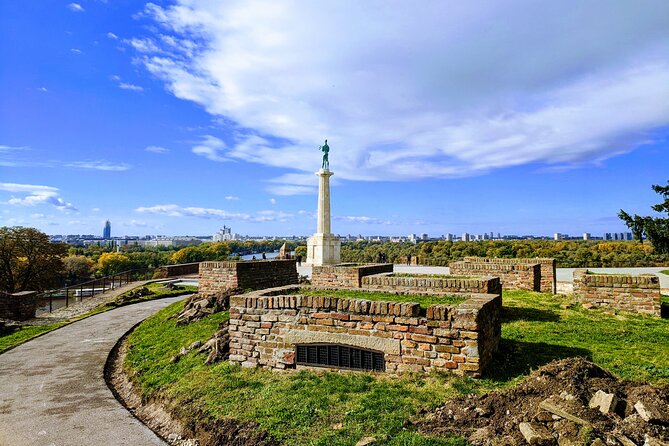
The route then climbs into the Upper Town of the fortress. One of the great rewards is the view where the Sava meets the Danube. The confluence explains Belgrade’s strategic importance better than any map or lecture can.
Along the way, you pass the Mehmed-pasha Sokolović Fountain and Defterdar’s Gate. From above, you can look toward the Lower Town and see the Main Gunpowder Storage, Karl VI’s Gate, and Nebojša Tower.
The fortress is a place where several eras sit close together. Roman foundations, medieval walls, Ottoman traces, and later military structures all occupy the same high ground. The guide’s explanations help you connect these remains instead of seeing them as disconnected stones.
Allow another 15 minutes for this section. You will want to pause for the view, and the open setting can feel hot in strong sun. Bring water, particularly if you are visiting in summer.
Victor, Belgrade’s best-known landmark
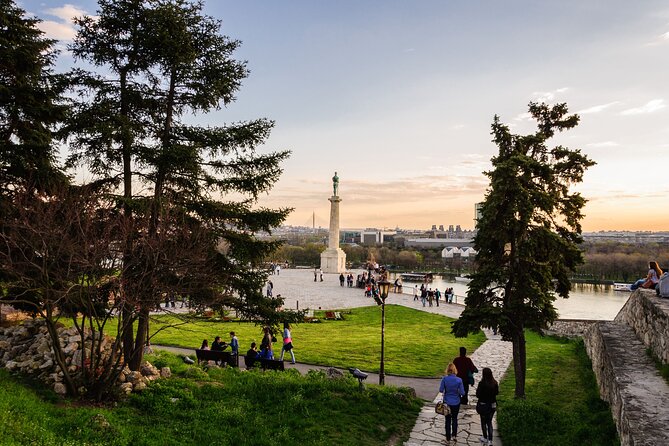
In the Upper Town, the route reaches the Victor monument, probably Belgrade’s most recognized landmark. The bronze figure was created by sculptor Ivan Meštrović and completed in 1928.
Victor commemorates Serbia’s victory over the Ottoman and Austro-Hungarian empires. Its position gives it a double role: it is a memorial to national triumph and a dramatic point from which to look across the rivers.
The monument is easy to photograph, but the explanation matters more than the image. Serbia’s modern identity was shaped by long struggles for independence, and Victor gives the guide a natural place to explain that history.
This stop takes about 15 minutes. It is also a good point to ask questions, especially if you want to understand how Belgrade’s monuments reflect national memory.
Gates, towers, and the route back through Kalemegdan
The walk continues past the Roman Well, King’s Gate, and the Sava Promenade. You also see the Damat Ali Pasha Tomb, the Clock Gate, and the Clock Tower.
The route passes the Military Museum and leaves the fortress through Istanbul Gate, also called Stambol Gate. Back in Kalemegdan Park, you see the Monument of Gratitude to France, another work by Ivan Meštrović, along with busts of important Serbian writers and cultural figures.
This section is packed with names and landmarks. If you enjoy military history, fortifications, and monuments, you will find plenty to keep your attention. If you prefer a slower visit, the amount of ground covered means you may want to return to the fortress on your own.
The tour is designed to give you the framework. It shows you what matters and helps you decide which places deserve more time later.
Kosančićev Venac, Belgrade’s artist quarter
After the park, the route heads toward Varoskapija along the Sava side of the old city. Here you see the Serbian Orthodox Patriarchy, Belgrade Cathedral, the old tavern known as The Question Mark, and the Residence of Princess Ljubica.
The Residence of Princess Ljubica is an elegant Balkan-style building. The Question Mark is Belgrade’s oldest tavern, giving this part of the walk a more everyday feel after the formal monuments of the fortress.
Then you enter Kosančićev Venac, a quiet quarter of cobblestone streets and older homes. Artists, galleries, photographers, sculptors, and art schools give the area its nickname, Belgrade Montmartre. The comparison is informal, but it helps explain the neighborhood’s creative identity.
This is the longest scheduled section, at about 40 minutes. It is also the part where the route feels most like a neighborhood walk rather than a checklist of major sights.
The guide points out the former site of the National Library of Serbia, destroyed during the Nazi bombing of Belgrade in 1941. That stop connects architecture with loss and gives you another way to understand the damage war caused to the city’s cultural life.
Expect uneven paving here. Comfortable shoes are more important than stylish ones.
King Peter Street and Knez Mihailova
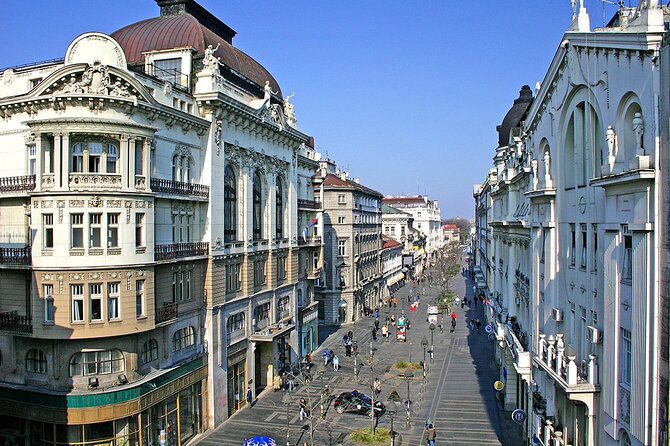
From Kosančićev Venac, you climb back toward the city center along King Peter’s Street. The route passes King Peter I Elementary School, the Neo-Renaissance palace of the National Bank of Serbia, and an Art Nouveau department store.
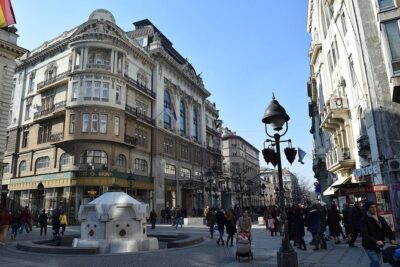
You then enter Knez Mihailova, Belgrade’s main pedestrian street. The walk back to Republic Square passes many examples of 19th and 20th-century civic architecture, including the Serbian Academy of Sciences and Arts.
This final stretch brings together the city’s Ottoman, medieval, royal, academic, and modern chapters. It also returns you to a lively central street where you can continue exploring, eat, shop, or find a café after the guide says goodbye.
The tour ends back at Republic Square. That is convenient if you are using the walk as your first orientation to Belgrade, since you finish in the same central area where you began.
Guide style and what the private format means
The tour is offered in English and includes a professional guide. Guides named in the supplied experiences include Jelica, Aleksandar, and Melissa. The best moments described in those accounts involve clear explanations of Serbian and Balkan history, thoughtful answers to questions, and useful suggestions for what to see or eat afterward.
One guide, Jelica, helped a visitor find other places of interest and suggested an ice cream stop during very hot weather. That kind of practical help can be valuable on a first day in Belgrade, when you are still working out how the center fits together.
Because this is a private activity, only your group participates. You can ask questions without worrying about holding up a large crowd, and the guide can respond to your interests. The tradeoff is price: $60.08 per person is not the cheapest way to see central Belgrade, especially for one person, but it can be fair value for a couple, family, or small group wanting personal attention.
Group discounts are available. Since the price is per person, check the final cost for your party before booking.
Timing, walking effort, and practical details
The tour runs approximately two to three hours, with operating hours listed from 10:00 a.m. to 4:00 p.m., Monday through Sunday. Meet at Republic Square, Trg Republike 3, near the Prince Mihailo monument. Hotel pickup and drop-off are not included.
You should have a moderate level of physical fitness. The route includes a long walk, fortress paths, cobblestones, and a climb back from the riverside quarter toward the center. Public transportation is nearby, and service animals are allowed.
All listed stops have free admission, so there are no standard entry fees added to the tour price. The main value comes from the guide’s interpretation, the private format, and the amount of ground covered.
You receive confirmation at booking. The child rate applies only when a child shares the tour with two paying adults. Free cancellation is available up to 24 hours before the start time. Cancellations or changes made within 24 hours are not accepted for a refund, and the activity requires a minimum number of participants to operate.
The experience is often booked about 40 days ahead. That does not guarantee every date will sell out, but it is a useful reason to reserve early if your Belgrade schedule is fixed.
Who should book this Belgrade walking tour?
I would choose this tour for a first visit, especially if you want a clear historical framework before exploring museums, restaurants, and neighborhoods on your own. The route covers the sights most people want to place on a map, but it also includes less obvious subjects such as Jewish Belgrade, Ottoman life, Captain Miša, and the former National Library site.
It suits couples, families, and small groups who value a private guide and plan to ask plenty of questions. It is also a good match for visitors with limited time, since Republic Square, Dorćol, the fortress, Kosančićev Venac, and Knez Mihailova are all connected in one walk.
I would think twice if you want long interior visits or a slow archaeological tour. The route is ambitious for two to three hours, and several stops receive only about 15 minutes. You will see a lot, but you may want to return to the fortress, Ružica Church, or Kosančićev Venac afterward.
At 4.9 out of 5 from 15 ratings, with 93 percent recommending it, the experience has a strong record. The praise centers on guides who explain difficult Serbian history clearly, answer questions, and make the walk feel personal. The lower rating still described it as a good, well-priced tour of the old city, which is a fair description of its role.
Should you book it?
Book this private Belgrade tour if you want an efficient first look at the city with an English-speaking guide, strong historical context, and memorable stops such as Victor and Ružica Church. The price is easiest to justify when shared by a small group, particularly if you appreciate asking questions and getting local suggestions.
Choose something else if your priority is a cheap group walk, extensive museum time, or a very relaxed pace. For most first-time visitors who can manage the walking, this is a useful and thoughtful introduction to Belgrade.
FAQ
Where does the Belgrade Old City walking tour start?
The tour starts at Republic Square, Trg Republike 3, in front of the Prince Mihailo horseman monument in Belgrade.
Where does the tour finish?
The activity finishes back at the meeting point at Republic Square.
How long does the tour take?
The tour lasts approximately two to three hours.
Is the tour private?
Yes. Only your group participates in this private activity.
Is hotel pickup included?
No. Hotel pickup and drop-off are not included.
What is the cancellation policy?
You can cancel up to 24 hours before the experience starts for a full refund. Cancellations or changes made less than 24 hours before the start time are not accepted for a refund.
Just added around Belgrade
- Private Wine Tasting by Party in Belgrade★ 5.0 · 3 reviews
- Zica and Studenica Monasteries Private Day Tour from Belgrade★ 5.0 · 4 reviews
- Urban & Alternative Belgrade tour★ 5.0 · 4 reviews
- Belgrade Bike Tour: Be a local in the hood of Belgrade!★ 5.0 · 5 reviews
- Sidecar Tours Belgrade★ 5.0 · 5 reviews
- The World of Pubs and Taverns: A Golden Mile★ 5.0 · 5 reviews
- Private Truffle‑Hunting Tour from Belgrade – Lunch with Wine★ 5.0 · 4 reviews
- Belgrade center walking tour with Rakija, Cocktails and Burgers★ 5.0 · 4 reviews
Walking Tours, compared.
Half-Day Sightseeing and Walking Tour of Belgrade City
Read our review →
BELGRADE BUS AND WALKING TOUR, Experience daily life
Read our review →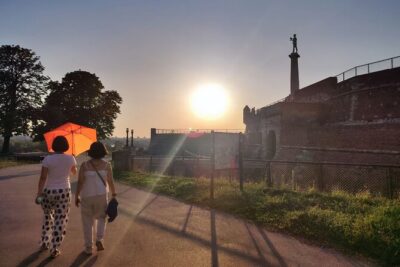
Small Group Walking Tour Around Old City of Belgrade
Read our review →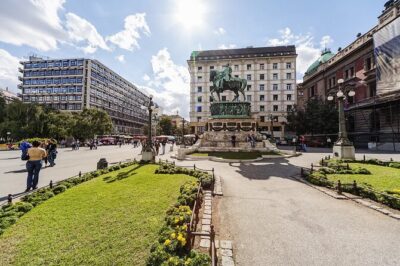
Browse the lists this tour appears in