
Reviewed · BELGRADE CITY TOURS
Belgrade Sightseeing Half-Day Trip Old and New Belgrade
Belgrade reveals its character quickly on this private half-day tour. In three hours, you move from Roman walls and Orthodox chapels at Kalemegdan to socialist-era concrete, Tito’s memorial, grand royal buildings, and the huge dome of Saint Sava Temple. It is a brisk but useful first look at a city shaped by empires, dynasties, communism, and modern Serbia.
I like the small-group format, which gives you a guide rather than a script read to a busload of people. I also like the mix of walking and driving: you explore the fortress on foot, then cover far more ground by air-conditioned car or minivan. The main drawback is time. Some stops are quick, and a few visitors found the tour closer to two hours than the advertised three.
Key points to know
- Kalemegdan begins the tour on foot, with fortress gates, Orthodox churches, and the Sava-Danube meeting point.
- New Belgrade adds a sharp change of mood, from socialist modernism and brutalist towers to newer business buildings.
- Dedinje and Tito’s memorial give you a look at Serbia’s political past and its grandest residential district.
- Saint Sava Temple is the main interior visit, with admission included.
- Hotel pickup and drop-off are included within five kilometers of Republic Square.
- The tour suits short stays best, especially a first morning in Belgrade or a long layover.
Why this three-hour route works for a first look
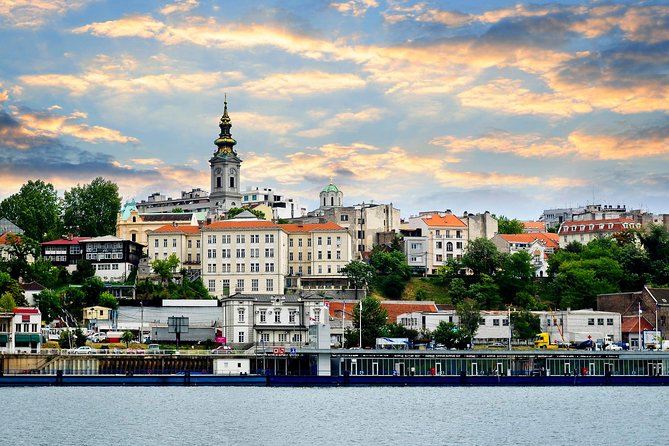
Belgrade is spread across two sides of the Sava River, and its most interesting sights do not sit in one tidy historic center. This tour solves that problem by combining a walking visit to the old fortress with a vehicle route through New Belgrade, Dedinje, Vračar, and the central squares.
You get a useful sense of the city’s contrasts. At Kalemegdan, the story reaches back to Roman Singidunum and medieval Serbia. In New Belgrade, wide avenues and concrete apartment blocks reflect the postwar socialist state. Around Kralja Milana Street, royal palaces and ministries bring you back to the architecture of prewar Serbia.
The tour is private, with only your group taking part. Transport is by private sedan for one to three people or an air-conditioned minivan for four to seven. That matters in Belgrade, where the route covers enough distance that a fully walking tour would take much longer.
Guides named in the guest feedback include Aleksandar, Alexander, Ivan, Milosh, Vladimir, and Stefan. Aleksandar received especially strong praise for explaining Serbia’s past clearly, adjusting the pace for a parent with limited walking ability, and confirming pickup ahead of time. Stefan was noted for giving plenty of context without burying the group in facts, while Vladimir added local knowledge about football and basketball.
The price is $150.85 per person. That is not a bargain for a three-hour city tour, especially if you are traveling alone. For a small private group, though, the cost pays for door-to-door transport, a dedicated English-speaking guide, fuel, parking, water, and the Saint Sava Temple entrance. Two or more people can find the price easier to justify than a solo visitor.
More belgrade city tours in Belgrade:
- Taxi to/from Belgrade Airport to/from Belgrade City Center
★ 5.0 · 241 reviews - Belgrade sightseeing by car
★ 5.0 · 40 reviews - Half-Day Sightseeing and Walking Tour of Belgrade City
★ 5.0 · 37 reviews
Kalemegdan Park and Belgrade Fortress
Your pickup begins at your hotel, Airbnb, pension, or the Belgrade port if it is within the stated area. The first stop is Kalemegdan, Belgrade’s oldest and largest central park, where the fortress occupies a high position above the meeting point of the Sava and Danube.
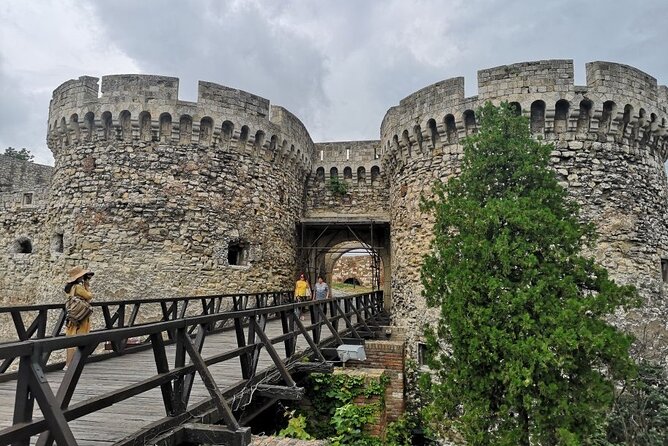
The walking section begins near Leopold’s Gate. From there, your guide explains the Roman castrum of Singidunum and the later medieval walls built over it. You pass Zindan Gate, Despot’s Gate, and Jakšića Tower, all linked to the fortress’s 15th-century defenses.
This is the part of the tour where comfortable shoes matter most. The route includes old stone surfaces and a moderate amount of walking, so the stated requirement for moderate physical fitness is worth taking seriously. The guide can reduce the walking load when needed, but you should mention a bad knee or limited mobility at booking.
Two small Orthodox churches add a more intimate note to the fortress visit. You see the Chapel of Saint Petka and Ružica Church, also known as the Church of the Virgin Mary. Their scale gives you a break from the fortress’s broad walls and military history.
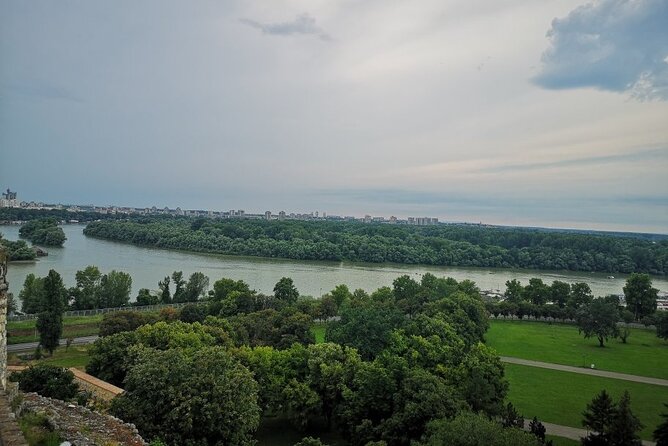
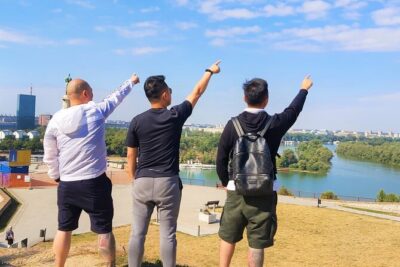
In the Upper Town, the view opens toward the confluence of the Sava and Danube. It is one of Belgrade’s best orientation points, and your guide can help you understand how the rivers shape the city. Allow yourself a moment here rather than treating it as just another photo stop.
Pobednik and the fortress gates
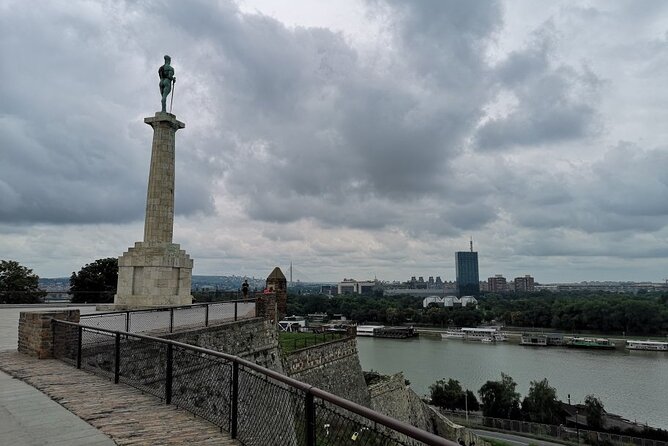
The walk continues to Pobednik, or the Victor monument, designed by Ivan Meštrović. The tall figure has become one of Belgrade’s defining sights, partly because of its position above the rivers and partly because it captures the city’s repeated cycle of conflict and renewal.
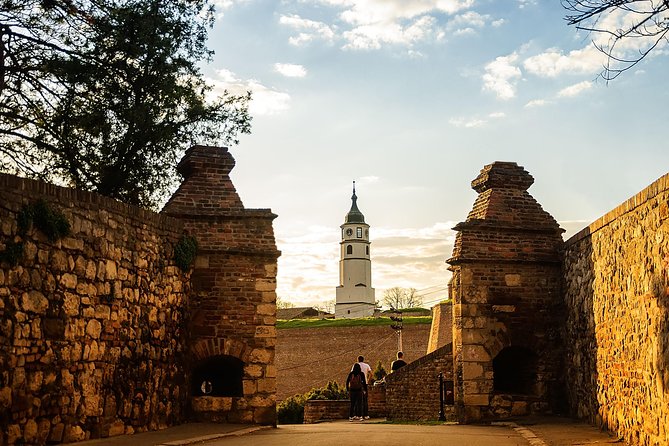
Nearby sights fill in the military story: the Roman Well, King’s Gate, Sava Promenade, Damat Ali Pasha’s Tomb, Sahatkapija Clock Gate, and Sahatkula Clock Tower. You also pass the Military Museum and leave through Stambol Gate, once the main route into the fortress from the direction of Istanbul.
Back in Kalemegdan Park, the Monument of Gratitude to France is another Meštrović work. The park also contains busts of Serbian writers and public figures. Your guide can connect these monuments to Serbia’s cultural and political story, but the short schedule means you should not expect detailed museum visits.
After this section, you return to the vehicle. This change is important: the tour does not ask you to walk across the whole city, and you avoid spending the morning on public transport or trying to piece together distant sights yourself.
New Belgrade and its concrete experiment
Across the river, New Belgrade gives you the city’s most dramatic change in style. Built mainly after the Second World War during the socialist period, this district was planned as a new administrative and residential center.
You pass the former Central Committee of the Communist Party, the Federal Executive Council building, and Genex Tower, also called the Western Gate of Belgrade. The Sava Center, one of the region’s major congress halls, is another key sight along the route.
You do not need to love brutalist architecture to find this section worthwhile. The massive forms, broad spaces, and government buildings show how Yugoslavia wanted to present itself as modern, independent, and different from both the West and the Soviet bloc. New Belgrade later attracted newer offices and business buildings, creating a mix of old socialist design and recent construction.
The district’s architecture gained international attention through the Museum of Modern Art exhibition Toward a Concrete Utopia. That detail helps explain why these buildings deserve more than a passing glance from a car window.
You also pass Novak, the restaurant associated with Novak Đoković’s family, and Belgrade Arena, the city’s major sports venue. These are brief drive-by sights, not stops for meals or events. If you follow tennis or basketball, they add a personal touch to the route. If not, they are simply useful markers in a large district.
A few more Belgrade trips to weigh up
- “Golden Standard” Private Half-Day Sightseeing Tour of Belgrade
★ 5.0 · 5 reviews
Dedinje, football rivalry, and Tito’s memorial
After crossing the Gazela Bridge, the route turns toward Dedinje, Belgrade’s most luxurious residential area. The district spreads across Topčider Hill, with large homes and greenery replacing New Belgrade’s hard-edged avenues.
Your guide explains the past connected with some of the properties. Dedinje’s houses are not just displays of wealth; many are tied to Serbia’s turbulent 20th century, when political power changed hands and private residences could acquire public significance.
Football fans get a local lesson here. Rajko Mitić Stadium, home of Red Star Belgrade, is the country’s biggest football stadium. Partizan Belgrade’s stadium sits across a small hill, and the rivalry between the clubs has lasted more than 70 years. Red Star’s 1991 European Cup victory also gives the rivalry a place in continental football history.
The route then reaches the Museum of History of Yugoslavia and the House of Flowers, where Josip Broz Tito is buried. The museum and memorial are among the clearest ways to connect Belgrade with the former Yugoslav state, but the tour presents them from outside unless your booking includes more time for a museum visit.
This is one of the tour’s practical limits. You see several important places, but you are not given a long museum session. If Tito, Yugoslavia, or socialist history is your main interest, you may want to return separately.
Saint Sava Temple and the Vračar district
From Dedinje, the car continues to Vračar and the Church of Saint Sava. This is the tour’s major religious and architectural stop, and entrance is included.
The temple was begun in the 1930s on the site where Ottoman forces burned the relics of Saint Sava, the founder and first archbishop of the independent Serbian Orthodox Church. For Serbian people, Saint Sava remains one of the central figures of national religious and cultural life.
The scale is hard to miss. The church covers about 3,500 square meters at floor level, with another 1,500 square meters in galleries. The dome reaches 70 meters, and the gilded cross adds another 12 meters, bringing the total height to 82 meters.
Inside, you can visit the decorated crypt of Saint Sava beneath the main floor. The tour allows about 30 minutes here, which gives you time to see the principal interior and absorb the scale, though not to inspect every detail at leisure.
Saint Sava is also a helpful stop for understanding modern Belgrade. Construction began before the Second World War, then continued through political upheaval and later decades. The building links medieval Serbian identity, Orthodox faith, and the long process of creating a national landmark in a modern capital.
Slavija, Nemanjina, and the royal quarter
Back in the vehicle, you pass Slavija Square and continue along Nemanjina Street. This road is lined with major government institutions, including the Government Building, Ministry of Foreign Affairs, General Staff of the Serbian Army, Ministry of Railways, Ministry of Finance, and the State Court.
The value here is visual context. You are not stopping at each ministry, but the buildings show the formal prewar face of Belgrade and help you read the city’s political center. Your guide fills in the connections between architecture and the state institutions that occupy these streets.
Kralja Milana Street brings you to the Old and New Royal Palaces and Nikola Pašić Square. The square’s monument honors the first prime minister of the Kingdom of Yugoslavia, while the palaces introduce the two royal dynasties that ruled Serbia in the 19th and 20th centuries.
You stop in front of the Serbian Parliament for photographs. The break lasts about ten minutes, so keep your camera ready and do not expect a full interior visit. The nearby Terazije Square adds a 19th-century fountain and the Moskva Hotel, one of central Belgrade’s most recognizable buildings.
Republic Square and the end of the tour
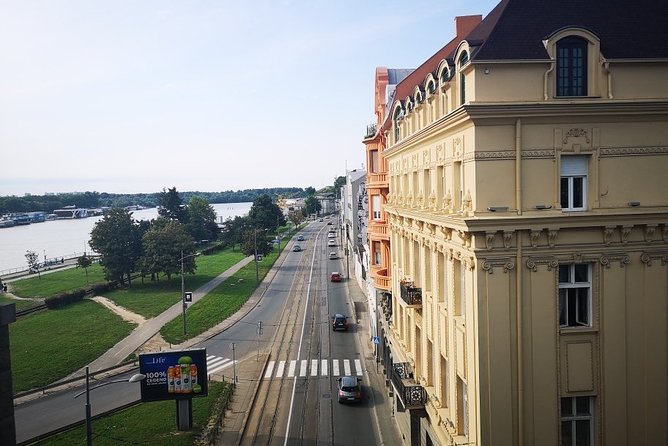
The tour ends at Republic Square, the center of Belgrade’s cultural life. The National Museum and National Theatre face the square, and the equestrian monument to Prince Mihailo points toward another important chapter in Serbia’s modern development.
This is a good place to finish because you are left in the center rather than returned to a remote parking area. From here, you can continue exploring on foot, stop for lunch, or use the square as your starting point for an afternoon visit to museums and central streets.
The final stop lasts about 15 minutes. Like the parliament stop, it is an overview rather than a full cultural visit. That suits the tour’s purpose: it gives you a map of Belgrade’s main quarters and enough background to choose where to spend more time later.
Timing, transport, and what the price covers
The scheduled start is 9:30 a.m., with pickup from addresses within five kilometers of Republic Square included. Pickup farther than five but less than ten kilometers costs an additional 10 euros. Airport pickup is available for a 15 euro supplement, which can make the tour useful during a long layover if your flight times line up.
The tour includes an air-conditioned sedan or minivan, fuel, parking fees, an English-speaking guide, hotel drop-off, a bottle of water, and Saint Sava Temple admission. Gratuities are optional.
The tour is often booked about 51 days ahead, and the listed satisfaction level is high, with a 4.7 rating from 71 responses and recommendation by 99 percent of customers. The strongest praise centers on guides who explain Serbia’s complicated past clearly, drive well, arrive on time, and adjust the route or walking pace to suit the group.
Still, the schedule can feel compressed. Kalemegdan alone deserves a longer visit if you want to study every gate and church. New Belgrade, Dedinje, the royal center, and Saint Sava Temple then follow in quick succession. In hot weather, the air conditioning and included water help, but bring a hat and comfortable shoes for the fortress.
Free cancellation is available up to 24 hours before the start time. Changes or cancellations inside that window are not accepted for a refund.
Who should book this Belgrade tour?
I would choose this tour if you have only one morning, a short stay, or a long layover. It gives you the essential first picture of Belgrade without making you solve the city’s distances yourself.
It also suits families and mixed-mobility groups better than a long walking tour. The private format lets the guide slow down, spend more time on a topic, or reduce walking when practical. Children may respond well to the fortress, river views, stadium rivalry, and stories about royal families and Tito.
You should think twice if you want extensive time inside museums, a leisurely coffee stop, or detailed photography at every location. The $150.85 price per person is strongest for a couple, family, or small group sharing the private vehicle. A solo visitor paying the full rate may find a public walking tour better value, unless convenience and broad coverage matter most.
Final verdict: a smart orientation with a quick pace
Book this tour if you want Belgrade’s old center and modern districts in one efficient outing. The fortress walk, Saint Sava Temple, New Belgrade’s architecture, and Dedinje create a well-rounded route, while guides such as Aleksandar, Ivan, Vladimir, and Stefan bring strong command of local history and practical care.
Do not book it expecting deep museum time or a slow day of wandering. Think of it as a private city briefing, one that helps you see how Belgrade fits together and decide where to return. For a first visit with limited time, that is a useful service.
FAQ
How long is the Belgrade sightseeing tour?
The advertised duration is approximately three hours. Some past participants found the actual experience closer to two hours, so allow extra time if you have a firm departure or appointment afterward.
Is hotel pickup included?
Yes. Free pickup and drop-off are available from hotels, Airbnbs, pensions, and the Belgrade port within five kilometers of Republic Square.
Can I be picked up farther from central Belgrade?
Yes. Pickup between five and ten kilometers from the city center has a 10 euro supplement. Pickup from Belgrade Airport is available for a 15 euro supplement. For locations farther than ten kilometers, you should contact the provider directly.
Is this a private tour?
Yes. Only your group takes part. Transport is by private sedan for one to three people or an air-conditioned minivan for four to seven people.
Is Saint Sava Temple admission included?
Yes. The entrance fee to Saint Sava Temple is included in the tour price.
What happens if I need to cancel?
You can cancel up to 24 hours before the experience begins for a full refund. Cancellations or changes made less than 24 hours before the start time are not refunded or accepted.
More 1-Day Tours in Belgrade
- Day Trip from Belgrade: Gems of Eastern Serbia
★ 5.0 · 424 reviews - Western Serbia 1-Day Tour of the Key Sites from Belgrade
★ 4.8 · 333 reviews - Along the Danube: Golubac Fortress & Iron Gate Gorge day trip from Belgrade
★ 4.5 · 185 reviews - Šargan Eight Railway, Wooden Town & House on Drina river day trip from Belgrade
★ 5.0 · 107 reviews
Just added around Belgrade
- Private Wine Tasting by Party in Belgrade★ 5.0 · 3 reviews
- Zica and Studenica Monasteries Private Day Tour from Belgrade★ 5.0 · 4 reviews
- Urban & Alternative Belgrade tour★ 5.0 · 4 reviews
- Belgrade Bike Tour: Be a local in the hood of Belgrade!★ 5.0 · 5 reviews
- Sidecar Tours Belgrade★ 5.0 · 5 reviews
- The World of Pubs and Taverns: A Golden Mile★ 5.0 · 5 reviews
- Private Truffle‑Hunting Tour from Belgrade – Lunch with Wine★ 5.0 · 4 reviews
- Private Day Trip/Transfer Tour from Belgrade to Timisoara★ 5.0 · 5 reviews
Belgrade City Tours, compared.
Half-Day Sightseeing and Walking Tour of Belgrade City
Read our review →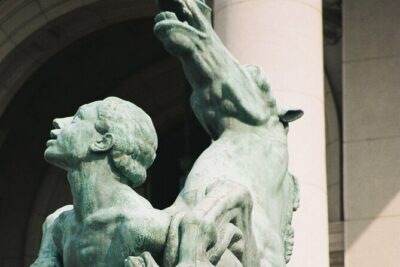
Browse the lists this tour appears in